|
|

| # 1 | |||||||||||||||||||||||||||||||||||||||||||||||||||||||||||||||||||||||||||||||||||||||||||||||||||||||||||||||||||||||||||||||||||||||||||||||||||||||||||||||||||||||||||||||||||||||||||||||||||||||||||||||||||||||||||||||||||||||||||||||||||||||||||||||||||||||||||||||||||||||||||||||||||||||||||
|
Администратор
|
Top FSA/JFSA Regulated FX & CFD Brokers in Japan
Top FSA/JFSA Regulated FX & CFD Brokers in JapanJapan stands as one of the world's most sophisticated and highly regulated financial markets, with a vibrant retail trading community that has embraced forex and CFD trading for decades. The Financial Services Agency (FSA), also known as the Japan Financial Services Agency (JFSA), enforces some of the strictest regulatory standards globally, ensuring exceptional protection for retail traders through comprehensive oversight, stringent capital requirements, and rigorous operational standards. This comprehensive guide examines the top 10 FSA-regulated and internationally regulated brokers serving Japanese traders in 2025, evaluating their regulatory credentials, trading conditions, platform technology, and suitability for Japan's unique market environment. All featured brokers either operate under direct FSA licensing or maintain robust tier-one regulation from authorities such as the UK's FCA, Australia's ASIC, or Switzerland's FINMA, ensuring the highest standards of client protection. Understanding Japan's FSA Regulatory FrameworkThe FSA operates one of the world's most stringent regulatory regimes for retail forex and CFD trading. Japanese regulations prioritize client protection through rigorous licensing requirements, mandatory segregation of client funds, comprehensive disclosure obligations, and strict capital adequacy standards. Key FSA regulatory protections for Japanese traders include:
Tax Considerations for Japanese TradersProfits from forex and CFD trading in Japan are subject to a separate taxation rate of approximately 20.315% (15% income tax, 5% local inhabitant tax, and 0.315% reconstruction tax). This applies to both domestic and overseas trading accounts. Japanese traders must file annual tax returns declaring trading profits, and losses can be carried forward for up to three years to offset future gains. Top 10 FSA/JFSA Regulated FX & CFD Brokers in JapanHere is a detailed analysis of the leading brokers serving Japanese traders, evaluating their regulatory standing, trading conditions, platform offerings, and overall suitability for Japan's sophisticated market. 1. INFINOX
INFINOX Broker Details
Founded in London in 2009, INFINOX is the best internationally regulated CFD broker for Japan, combining award-winning technology with highly competitive trading conditions under the robust oversight of the UK's Financial Conduct Authority. While not directly FSA-licensed for Japanese operations, INFINOX serves Japanese traders through its FCA-regulated entity, providing access to global markets with exceptional regulatory protection and innovative trading solutions. INFINOX's key advantage lies in its versatile account structure: a zero-commission STP account for straightforward trading and a raw-spread ECN account for advanced traders demanding institutional-grade execution. The broker distinguishes itself through its proprietary IX Social platform, an innovative copy trading solution that enables Japanese traders to learn from and replicate the strategies of experienced market participants globally. With comprehensive support for Japanese yen accounts, multilingual customer service, and robust FCA oversight including segregated client funds and negative balance protection, INFINOX provides Japanese traders with a secure and transparent gateway to international markets beyond FSA restrictions. Regulatory Transparency: In January 2025, the FCA issued INFINOX a fine related to historic transaction reporting failures. The matter was resolved promptly, and the broker has since strengthened its reporting systems. INFINOX remains in full compliance with all regulatory obligations and continues to operate with the highest standards of client protection and market integrity. Key Pros
Key Cons
2. IG Markets
IG Markets Broker Details
IG Markets is one of the world's oldest and most respected brokers, established in 1974, and operates with direct FSA licensing in Japan. As a publicly traded company on the London Stock Exchange, IG provides Japanese traders with unparalleled transparency, financial stability, and regulatory compliance. The broker's Japanese entity strictly adheres to all FSA requirements including the 25:1 leverage cap, trust bank fund segregation, and comprehensive Japanese-language disclosure. IG Markets' proprietary trading platform is renowned for its professional-grade functionality, offering advanced charting tools, comprehensive market analysis, and seamless execution across over 17,000 global markets (with Japan-specific offerings compliant with FSA rules). The platform's Japanese interface is fully localized, and IG provides extensive educational resources, daily market commentary, and professional customer support in Japanese. For Japanese traders prioritizing domestic regulatory oversight and institutional-grade infrastructure, IG Markets represents the gold standard. Key Pros
Key Cons
3. OANDA
OANDA Broker Details
OANDA is a pioneering forex broker with a rich history dating back to 1996, operating with direct FSA licensing in Japan and providing exceptional transparency through its innovative trading technology. OANDA Japan (OANDA Securities Co., Ltd.) is fully licensed by the FSA and adheres strictly to all Japanese regulatory requirements, including mandatory trust bank segregation and the 25:1 leverage limit. OANDA's core strength lies in its proprietary trading technology, which offers fractional pip pricing for enhanced transparency and the ability to trade in any position size down to one unit of base currency. This flexibility is particularly valuable for Japanese traders practicing risk management or testing strategies with minimal capital. The OANDA Trade platform features advanced order types, comprehensive charting with TradingView integration, and seamless mobile trading. With competitive spreads, zero commissions, and a strong commitment to algorithmic trading support through robust API access, OANDA is an excellent choice for both retail and algorithmic traders in Japan. Key Pros
Key Cons
4. AvaTrade JP
AvaTrade JP Broker Details
AvaTrade operates in Japan through Ava Trade Japan K.K., a fully FSA-licensed entity that adheres to all Japanese regulatory requirements. Established globally in 2006, AvaTrade has built a strong reputation for regulatory compliance, trader education, and innovative risk management tools. The Japanese entity provides domestic traders with the security of FSA oversight while benefiting from AvaTrade's global expertise and technological innovation. AvaTrade JP's platform diversity is exceptional for an FSA-regulated broker, offering MetaTrader 4 and 5 for technical traders, the intuitive AvaTradeGO mobile app optimized for Japanese users, and AvaOptions for vanilla options trading. The broker places strong emphasis on education, providing comprehensive webinars, trading courses, and daily market analysis in Japanese. AvaTrade JP also offers unique features such as AvaProtect (where available under FSA rules), which allows traders to protect open positions against losses for a specified period. For Japanese traders seeking a well-regulated domestic broker with international backing, AvaTrade JP is a compelling choice. Key Pros
Key Cons
5. Plus500
Plus500 Broker Details
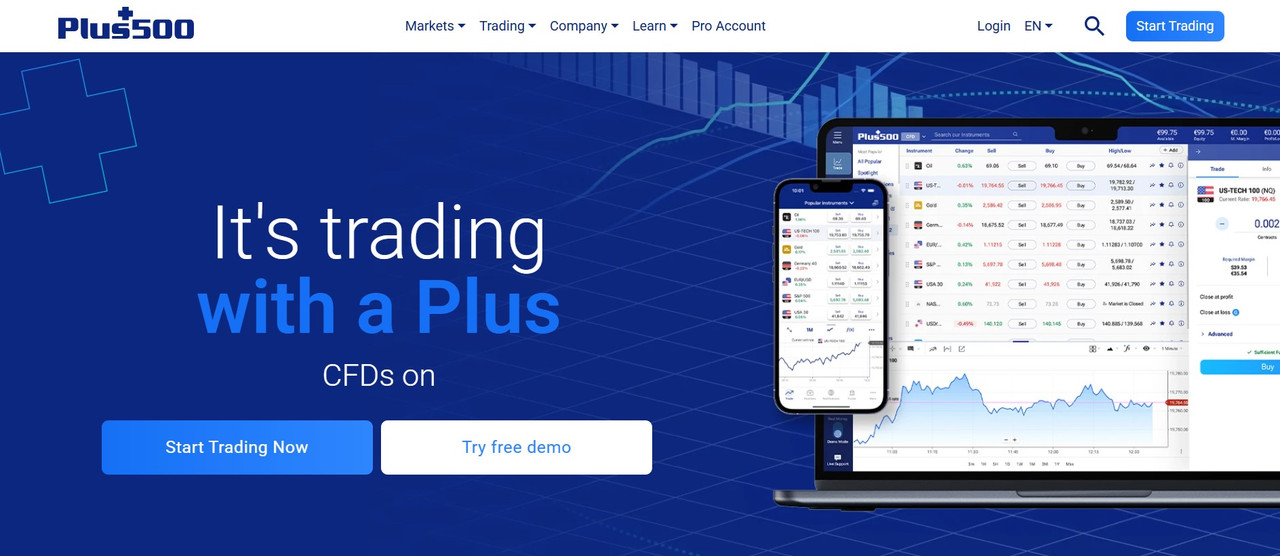
Plus500 is a publicly traded, multi-regulated CFD provider renowned for its streamlined, user-friendly trading platform that eliminates complexity without sacrificing essential functionality. While Plus500 serves Japanese traders through its internationally regulated entities (primarily FCA) rather than direct FSA licensing, it provides a secure and transparent trading environment with access to over 2,800 instruments across all major asset classes. The platform's greatest strength lies in its exceptional simplicity and clarity. Plus500's proprietary interface features intuitive navigation, clear real-time pricing displays, and powerful risk management tools including guaranteed stop-loss orders on many instruments. The platform is fully optimized for both desktop and mobile trading, with Japanese language support throughout. Japanese traders benefit from zero commissions, competitive dynamic spreads, and complete transparency with no hidden fees. For traders seeking a straightforward, well-regulated international broker with higher leverage options than FSA permits, Plus500 delivers excellent value. Key Pros
Key Cons
6. Saxo Bank
Saxo Bank Broker Details
Saxo Bank is a premium Danish investment bank offering Japanese traders institutional-grade trading and investment services through its globally regulated infrastructure. While Saxo primarily serves Japanese clients through its international entities rather than FSA licensing, it provides the highest level of security as a fully licensed European bank with comprehensive oversight from Denmark's FSA (Finanstilsynet), the FCA, and other tier-one regulators. Saxo Bank's offering extends far beyond standard forex and CFD trading, providing access to over 70,000 instruments including stocks, bonds, ETFs, options, and futures across global exchanges. The proprietary SaxoTraderPRO platform is renowned for its professional-grade functionality, offering advanced charting, comprehensive fundamental analysis, and seamless multi-asset trading capabilities. For experienced, well-capitalized Japanese traders seeking comprehensive market access, institutional research, and the security of a fully licensed bank, Saxo Bank represents the premium choice. Key Pros
Key Cons
7. Interactive Brokers
Interactive Brokers Broker Details
Interactive Brokers is one of the world's largest and most respected brokerage firms, offering Japanese traders institutional-grade access to over 150 global markets spanning stocks, options, futures, forex, bonds, and funds. Regulated by top-tier authorities including the SEC, FCA, and ASIC, Interactive Brokers sets the gold standard for professional traders and serious investors who demand comprehensive market access, transparent pricing, and cutting-edge technology. The broker's legendary Trader Workstation (TWS) platform offers unmatched functionality including advanced order types, comprehensive risk analytics, algorithmic trading capabilities, and real-time portfolio analysis with multi-currency support. For Japanese traders seeking to build diversified international portfolios beyond forex and CFDs, Interactive Brokers is unparalleled. The tiered commission structure rewards high-volume traders with some of the industry's lowest per-trade costs. While Interactive Brokers serves Japanese traders through its international entities rather than FSA licensing, it provides exceptional security as a publicly traded company with transparent financials and SEC oversight. Key Pros
Key Cons
8. Dukascopy
Dukascopy Broker Details
Dukascopy is a Swiss-regulated banking group offering Japanese traders the unique combination of Swiss banking security with advanced forex trading technology. Dukascopy operates both through its FINMA-regulated Swiss entity and Dukascopy Japan, which maintains FSA licensing for full domestic regulatory compliance. This dual structure allows Japanese traders to choose between strict FSA oversight with lower leverage or Swiss regulation with higher capital efficiency. Dukascopy's proprietary JForex platform is highly regarded for its professional-grade functionality, offering advanced order types, comprehensive backtesting capabilities, and powerful automated trading tools. The platform excels in transparency, providing direct market access with Level II pricing and comprehensive trade execution statistics. Dukascopy also operates the Swiss Forex Marketplace (SWFX), a transparent ECN that aggregates liquidity from multiple sources. For Japanese traders prioritizing transparency, Swiss banking security, and advanced trading technology, Dukascopy represents a compelling choice. Key Pros
Key Cons
9. Moomoo
Moomoo Broker Details
Moomoo is a next-generation fintech platform owned by Futu Holdings, a NASDAQ-listed company, offering Japanese traders advanced technology-driven access to global stock markets. While Moomoo's primary focus is stock trading rather than forex and CFDs, it has gained significant traction in Japan for its innovative mobile-first platform, professional-grade charting tools, and vibrant trading community features. The Moomoo platform stands out for its exceptional real-time market data, advanced technical analysis tools, and social trading features that allow Japanese traders to share ideas, analyze trends, and learn from successful investors. The platform offers institutional-grade Level II market data, customizable watchlists, and comprehensive fundamental analysis tools. For Japanese traders interested in diversifying beyond forex into global equities with cutting-edge technology and competitive commission structures, Moomoo provides a modern alternative to traditional brokers. Key Pros
Key Cons
10. IC Markets
IC Markets Broker Details
IC Markets is globally renowned for its institutional-grade "True ECN" trading environment, serving Japanese traders through its ASIC and CySEC-regulated entities. While not directly FSA-licensed, IC Markets is a top choice for Japanese traders who prioritize ultra-low costs, offering some of the tightest spreads and lowest commissions globally. The broker's infrastructure is built for speed and reliability, making it ideal for algorithmic traders, scalpers, and high-frequency trading strategies. IC Markets' core strength lies in its pure ECN execution model, providing access to deep liquidity pools from tier-one banks and non-bank liquidity providers. This results in lightning-fast order execution with minimal slippage and complete transparency. The broker offers exceptional platform diversity, supporting MetaTrader 4 and 5 for automated trading and cTrader for advanced manual execution. With raw spreads starting from 0.0 pips and commissions from ¥600 per round turn, IC Markets delivers outstanding value for active Japanese traders willing to use internationally regulated brokers for capital efficiency beyond FSA restrictions. Key Pros
Key Cons
How to Choose the Best Broker for Your Trading NeedsSelecting the right broker is a critical decision that fundamentally shapes a trader's market experience and long-term success. Japanese traders benefit from one of the world's most sophisticated regulatory environments and should evaluate brokers based on several core principles. Determine Regulatory Preference: Japanese traders must first decide whether they prioritize direct FSA licensing or are comfortable with internationally regulated brokers. FSA-licensed brokers like IG Markets, OANDA Japan, and AvaTrade JP provide domestic regulatory coverage, trust bank fund segregation, and adherence to Japan's 25:1 leverage cap. These brokers offer maximum local regulatory protection and Japanese-language compliance documentation. Alternatively, internationally regulated brokers like INFINOX (FCA), IC Markets (ASIC), or Saxo Bank (FINMA) provide access to higher leverage for professional traders, broader instrument selection, and potentially more competitive trading costs, while still maintaining robust tier-one regulatory oversight.
Broker Comparison Table (2025)
|
|||||||||||||||||||||||||||||||||||||||||||||||||||||||||||||||||||||||||||||||||||||||||||||||||||||||||||||||||||||||||||||||||||||||||||||||||||||||||||||||||||||||||||||||||||||||||||||||||||||||||||||||||||||||||||||||||||||||||||||||||||||||||||||||||||||||||||||||||||||||||||||||||||||||||||